

Brandon Elm
The Brandon Elm is a selection of the native American Elm that grows on the eastern prairies. It was chosen for it’s consistent upright vase form, dense ascending branch structure and being considerably more compact. The leaves are dark green with a serrated margins and turn a golden yellow in the fall. The tree can be trained to have a raised lower branches which makes it suitable for locations with visibility and clearance concerns. Brandon Elms are hardy, drought and urban tolerant. The tree is highly versatile and widely planted for good reason.


| Common Name |
Brandon Elm |
|---|---|
| Latin Name |
Ulmus americana 'Brandon' |
| Form |
Vase Shaped |
| Life Span |
100+ |
| Growth Rate |
Fast when young and then moderate |
| Mature Height |
12m |
| Mature Spread |
7.5m |
| Flower Colour |
Inconspicuous |
| Fragrance |
Not significant |
| Fall Colour |
Yellow |
| Soil Preference |
Adaptable to All |
| Exposure Preference |
Full sun |
| Cold Hardiness Zone |
Zone 2a |
| Special Attributes and Considerations |
A notable feature of Brandon and American of Elms is that as the tree grows the base of the tree flares and forms buttresses like trees of the tropics. Dutch Elm Disease is a major concern with Brandon and American of Elms. Special considerations must made to help keep Alberta DED free. Only prune American Elm between October 1st and March 31st. The reason for this is beetle that spreads the fungus that causes DED is attracted to fresh wounds on Elm trees. |
| Folk Lore |
The Brandon Elm was selected by Lacombe Nurseries in central Alberta in around 1969. |
| Available Sizes |
40mm |
Related products

American Elm
American Elms are a large, long lived, stately tree. They are considered amongst the most beautiful and graceful trees that can be grown in the prairies. You will positively enjoy how their long slender branches gently sway in a breeze. Their leaves turn a golden yellow in the fall. American Elms are the trees that magnificently shade both North and South 1st Street in Medicine Hat with their cathedral-like ceiling of branches. They are exceptionally hardy and tolerant of even the most harsh planting site.
Bailey Select Sherbert Chokecherry
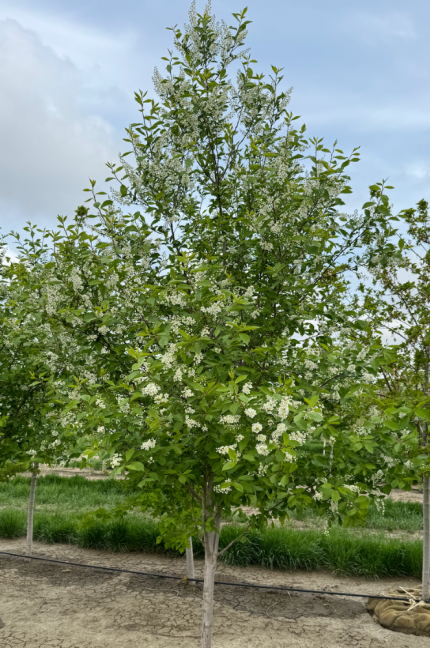
The Bailey Select Sherbert Chokecherry is a cultivated selection of the same chokecherry that grows wild in our region, with foliage that emerges green in spring and turns a rich purple by mid-summer. In spring, the tree produces a beautiful display of white, wonderfully fragrant panicles, followed by large crops of astringent black cherries that are mostly enjoyed by foraging birds. True to tradition, the fruit can also be used to make delicious chokecherry jam, just like in the old days.

Dropmore Linden
The Dropmore Linden is hybrid between the native American Linden and the European Little Leaf Linden. This breeding resulted in a regal tree fit to grow in the most discerning grounds. The tree grows with a strong central leader and a trunk with substantial girth. Leaves are densely growing, dark green and heart shaped. In early summer the tree will burst into colour with clusters of exceptionally fragrant yellow flowers. The tree is an excellent source of nectar for honey bees. The tree has a long history of being the most prairie hardy Linden and is to be considered a low maintenance selection.

Golden Willow
The Golden Willow is a hardy shelter belt tree that grows with a round form and slender drooping branches. The tree will grow to a large stature and tends to prefer a low canopy. As implied with it’s name, young stems are adorned with a beautiful yellow hue. The tree grows with glossy green, narrow (lanceolate) leaves. In autumn the leaves will turn golden yellow. As the tree ages the trunk’s bark will become deeply furrowed. The tree is typically found growing in a multi-trunk form, how ever we also have single trunk selections.

Green Ash
The Green Ash is a time tested and true tree for the prairies. They are amongst the hardiest of trees for our region. The tree boasts glossy dark green leaves that are pinnately compound with five to nine large leaflets. Autumn turns these leaves a golden yellow. The tree has greyish brown bark with interlacing furrows and ridges that produce a distinctive diamond pattern. Green Ash are cold, drought and urban tolerant making them widely suitable for any application. Green ash are native to South Eastern Alberta and have have been planted in our parks and yards since the very beginning.

Princess Kay Plum
The Princess Kay Plum brings beauty to any yard it grows within. The tree explodes with a brilliant display of precocious double white flowers in early spring. The leaves are dark green and transition to yellow / red in the fall. The tree is very compact making it a perfect addition to smaller sites. Princess Kay Plums will only grow a tiny amount of fruit so they considered to be very neat and tidy. The tree is cold hardy and makes a fine year around accent tree.
Sargent Poplar

Showy Mountain Ash
The Showy Mountain Ash features showy white spring flowers, pinnately compound leaves and striking red fall fruit. The berries often remain on the tree after the leaves fall, which provides a pleasant winter appearance. The tree is excellent at attracting birds to any yard. The leaves are dark green and transition to orange / red in the fall. Bark is typically smooth and grey, becoming scaly as the tree matures. The tree is slow growing and compact, making it a perfect addition to smaller sites. The tree can be planted as an accent or shade tree.
