

Green Ash
The Green Ash is a time tested and true tree for the prairies. They are amongst the hardiest of trees for our region. The tree boasts glossy dark green leaves that are pinnately compound with five to nine large leaflets. Autumn turns these leaves a golden yellow. The tree has greyish brown bark with interlacing furrows and ridges that produce a distinctive diamond pattern. Green Ash are cold, drought and urban tolerant making them widely suitable for any application. Green ash are native to South Eastern Alberta and have have been planted in our parks and yards since the very beginning.


| Common Name |
Green Ash |
|---|---|
| Latin Name |
Fraxinus Pennsylvanica |
| Form |
Oval ,Round |
| Life Span |
100 |
| Growth Rate |
Moderate |
| Mature Height |
15m |
| Mature Spread |
12.0m |
| Flower Colour |
Inconspicuous |
| Fragrance |
Insignificant |
| Fall Colour |
Yellow |
| Soil Preference |
Widely adaptable |
| Exposure Preference |
Full sun ,Partial shade |
| Cold Hardiness Zone |
Zone 2b |
| Special Attributes and Considerations |
The tree can produce samaras which some owners find messy. The Emerald Ash Borer is serious treat to all Ash trees and unfortunately the beetle continues to spread across North America. |
| Folk Lore |
The wood of an ash tree makes most excellent tool handles. Luthiers also prefer to use the wood of ash tree in the construction of their guitars. |
| Available Sizes |
40mm |
Related products

American Elm
American Elms are a large, long lived, stately tree. They are considered amongst the most beautiful and graceful trees that can be grown in the prairies. You will positively enjoy how their long slender branches gently sway in a breeze. Their leaves turn a golden yellow in the fall. American Elms are the trees that magnificently shade both North and South 1st Street in Medicine Hat with their cathedral-like ceiling of branches. They are exceptionally hardy and tolerant of even the most harsh planting site.

Box Elder
The Box Elder is a native tree that can often be found growing along streams and rivers. Some folks may know this tree as a Manitoba Maple. The tree is exceptionally drought and cold tolerant. A Box Elder can thrive in the most unforgiving location. Displaying plenty of character they often grow with gnarled and twisted branches. As the wood is weak and females will drop samaras, the Box Elder is best suited as a shade tree in a large yard or as a shelter belt tree in a rural setting.

Brandon Elm
The Brandon Elm is a selection of the native American Elm that grows on the eastern prairies. It was chosen for it’s consistent upright vase form, dense ascending branch structure and being considerably more compact. The leaves are dark green with a serrated margins and turn a golden yellow in the fall. The tree can be trained to have a raised lower branches which makes it suitable for locations with visibility and clearance concerns. Brandon Elms are hardy, drought and urban tolerant. The tree is highly versatile and widely planted for good reason.

Bur Oak
Bur Oaks are an exceptionally long lived tree that with time can reach truly massive proportions. They are an excellent selection for making a statement or as a shade tree with some authority. Bur Oaks are best suited for large open spaces. They are the most cold tolerant of all the oaks. When young, they are known to have a corky bark and branches. Their large acorns are prized by wildlife and are quickly carried off by birds and small mammals. When you plant a Bur Oak tree, you are really planting a tree for future generations.
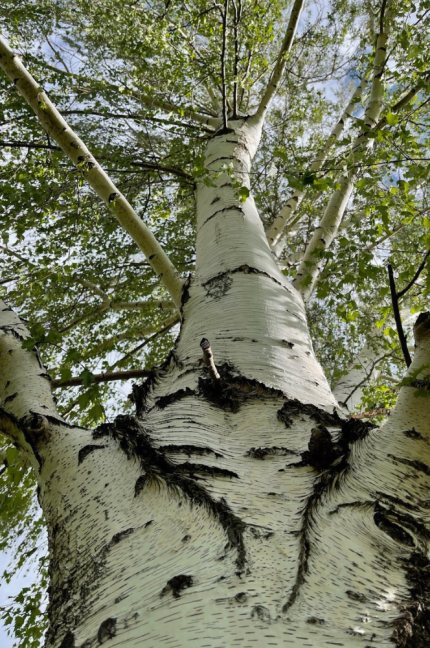
Prairie Dream Birch
The Prairie Dream Birch is a paper birch with beautiful fair white bark and attractive green leaves. With time the bark on the lower trunk peels into neat little rolls that are a favourite for youngsters. The leaves are pointy and dark green with a doubly serrated margin. They turn a golden yellow in fall. This cultivar is low maintenance and more adaptable than other varieties of birch. The Prairie Dream Birch has demonstrated exceptional resilience to the the birch bark borer.

Showy Mountain Ash
The Showy Mountain Ash features showy white spring flowers, pinnately compound leaves and striking red fall fruit. The berries often remain on the tree after the leaves fall, which provides a pleasant winter appearance. The tree is excellent at attracting birds to any yard. The leaves are dark green and transition to orange / red in the fall. Bark is typically smooth and grey, becoming scaly as the tree matures. The tree is slow growing and compact, making it a perfect addition to smaller sites. The tree can be planted as an accent or shade tree.

Silver Cloud Maple
The Silver Cloud Maple is a selection of the native species that is seedless, has superior cold hardiness and a more balanced branch structure. The tree is adorned with bright green 5 lobed maple leaves that shimmer in the wind with a silvery underside. This Maple also stands out due to it’s attractive silver bark. The tree is fast growing and drought tolerant. The Silver Cloud Maple is an excellent addition to any grounds with adequate space as a feature or shade tree.
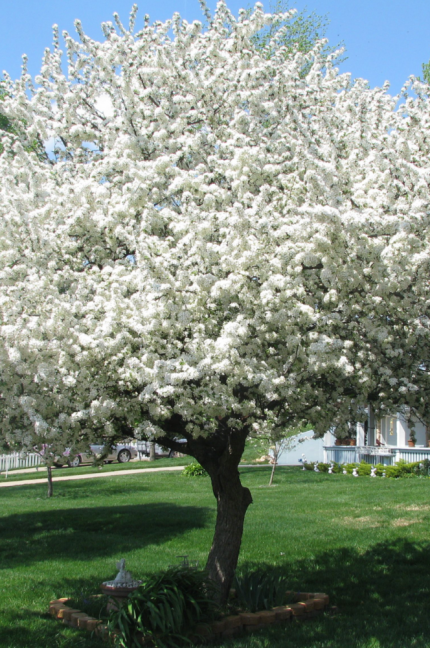
Spring Snow Crabapple
The Spring Snow Crabapple blooms in early to mid-spring with a profusion of beautiful, highly fragrant white flowers that make the tree look as though it has been covered in fresh snow. This compact tree is fully hardy for our region and, being a fruitless cultivar, remains clean and tidy throughout the season. It features distinctive orange-tinged bark and dark green, pointed leaves that turn yellow in fall, and when in bloom it is excellent for attracting hummingbirds and honey bees.
