

Thunderchild Flowering Crab Apple
Thunderchild Flowering Crabapples are an attractive, compact and upright tree that make the perfect focal point for any garden. During middle spring, the branches are draped with clusters of vibrant pink flowers. Its fruit is perfectly edible and tends to remain on the tree long into winter. The tree displays a dark purple foliage throughout the growing season. Thunderchilds are strongly resistant of fire blight. They are an absolute delight for bees, butterflies and birds alike.


| Common Name |
Thunderchild Flowering Crabapple |
|---|---|
| Latin Name |
Malus 'Thunderchild' |
| Form |
Oval |
| Life Span |
50= |
| Growth Rate |
Medium |
| Mature Height |
5.0m |
| Mature Spread |
3.5m |
| Flower Colour |
Pink ,Rosy |
| Fragrance |
Very Fragrant |
| Fall Colour |
Bronzy |
| Soil Preference |
Widely adaptable |
| Exposure Preference |
Full sun |
| Cold Hardiness Zone |
Zone 2b |
| Special Attributes and Considerations |
The Thunderchild is a crabapple tree that will produce small marble sized pomes which can be made into jelly, juice and wine. If the tree is planted too close to driveways or sidewalks the fruit may be considered messy. |
| Folk Lore |
The Thunderchild was introduced by Mr. Percy Wright (1898 – 1989) near Saskatoon, Saskatchewan in 1977. Having grown up in a sod house, being inflicted by severe childhood illness and forced to overcome numerous hardships throughout his years, this man knew a thing or two of the pioneering spirit. Mr. Wright earned his Masters Degree in English and was an accomplished teacher, musician, newspaper reporter and nurseryman. |
| Available Sizes |
40mm |
Related products

Black Walnut
Black Walnut Trees are a relatively rare tree for Southern Alberta but they have long been successfully grown in Medicine Hat. They make excellent shade trees and offer a splendid dappled shade with their loose open canopy. As a delicious autumn treat they produce large bounties of rich tasting nuts. They are low maintenance and exceptionally pest and disease resilient. They produce a brilliant fall show of bright yellow leaves. All and all we can not say enough good things about the Black Walnut tree as a consideration for anyones yard with appropriate space.

Box Elder
The Box Elder is a native tree that can often be found growing along streams and rivers. Some folks may know this tree as a Manitoba Maple. The tree is exceptionally drought and cold tolerant. A Box Elder can thrive in the most unforgiving location. Displaying plenty of character they often grow with gnarled and twisted branches. As the wood is weak and females will drop samaras, the Box Elder is best suited as a shade tree in a large yard or as a shelter belt tree in a rural setting.

Bur Oak
Bur Oaks are an exceptionally long lived tree that with time can reach truly massive proportions. They are an excellent selection for making a statement or as a shade tree with some authority. Bur Oaks are best suited for large open spaces. They are the most cold tolerant of all the oaks. When young, they are known to have a corky bark and branches. Their large acorns are prized by wildlife and are quickly carried off by birds and small mammals. When you plant a Bur Oak tree, you are really planting a tree for future generations.

Dropmore Linden
The Dropmore Linden is hybrid between the native American Linden and the European Little Leaf Linden. This breeding resulted in a regal tree fit to grow in the most discerning grounds. The tree grows with a strong central leader and a trunk with substantial girth. Leaves are densely growing, dark green and heart shaped. In early summer the tree will burst into colour with clusters of exceptionally fragrant yellow flowers. The tree is an excellent source of nectar for honey bees. The tree has a long history of being the most prairie hardy Linden and is to be considered a low maintenance selection.

Parkland Pillar Birch
The Parkland Pillar Birch is a beautiful tree that was derived from the Japanese White Birch. The tree grows with a commanding columnar form comprised of very dense dark green leaves. Typical of the birch species, it’s leaves are small, pointed and have serrated margins. The leaves turn to golden yellow in autumn and slowly shed, reviling it’s inner white bark. The Parkland Pillar Birch can be planted as a single accent tree, in a group or as a privacy screen.

Pembina Plum
The Pembina Plum is hybrid between a Canadian and Japanese plum that was bred over 100 years ago. The tree shows a brilliant display of precocious white flowers in the spring and in late August offers an absolutely delicious plum. The fruit displays a dark red skin and yellow flesh. The fruit is of the clingstone variety, which simply describes how the flesh does not easily pull away from the pit. The tree is very cold hardy and makes a fine year around accent tree. It is indeed a glorious moment to walk over to your Pembina Plum and indulge in a sweet and juicy plum you grew right in your own back yard.
Prairie Dream Birch
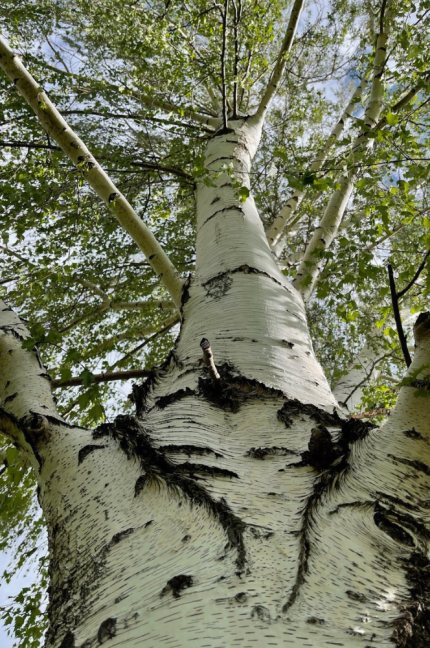
The Prairie Dream Birch is a paper birch with beautiful fair white bark and attractive green leaves. With time the bark on the lower trunk peels into neat little rolls that are a favourite for youngsters. The leaves are pointy and dark green with a doubly serrated margin. They turn a golden yellow in fall. This cultivar is low maintenance and more adaptable than other varieties of birch. The Prairie Dream Birch has demonstrated exceptional resilience to the the birch bark borer.

Silver Cloud Maple
The Silver Cloud Maple is a selection of the native species that is seedless, has superior cold hardiness and a more balanced branch structure. The tree is adorned with bright green 5 lobed maple leaves that shimmer in the wind with a silvery underside. This Maple also stands out due to it’s attractive silver bark. The tree is fast growing and drought tolerant. The Silver Cloud Maple is an excellent addition to any grounds with adequate space as a feature or shade tree.
