

Bur Oak
Bur Oaks are an exceptionally long lived tree that with time can reach truly massive proportions. They are an excellent selection for making a statement or as a shade tree with some authority. Bur
Oaks are best suited for large open spaces. They are the most cold tolerant of all the oaks. When young, they are known to have a corky bark and branches. Their large acorns are prized by wildlife and are quickly carried off by birds and small mammals. When you plant a Bur Oak tree, you are really planting a tree for future generations.


| Common Name |
Bur Oak |
|---|---|
| Latin Name |
Quercus macrocarpa |
| Form |
Round |
| Life Span |
300+ |
| Growth Rate |
Slow |
| Mature Height |
25m+ |
| Mature Spread |
25+ |
| Flower Colour |
Inconspicuous |
| Fragrance |
Not significant |
| Fall Colour |
Bronzy |
| Soil Preference |
Widely adaptable |
| Exposure Preference |
Full sun |
| Cold Hardiness Zone |
Zone 2b |
| Special Attributes and Considerations |
A unique characteristic of the Bur Oak is that they hold onto their leaves well into winter, which can help to offer privacy and tame the winter winds. This characteristic is know as having marcescent leaves. |
| Folk Lore |
Our European ancestors have for millennia used the wood of oak trees for building ships, weapons and the roof trusses of Europes greatest Cathedrals. Oak trees were worshipped by the druids whom often met to have their esoteric gatherings under the gnarly branches of Oak groves. The Green Man, an ancient symbol of fertility is often depicted with oak leaves and acorns. |
| Available Sizes |
40mm |
Related products

Box Elder
The Box Elder is a native tree that can often be found growing along streams and rivers. Some folks may know this tree as a Manitoba Maple. The tree is exceptionally drought and cold tolerant. A Box Elder can thrive in the most unforgiving location. Displaying plenty of character they often grow with gnarled and twisted branches. As the wood is weak and females will drop samaras, the Box Elder is best suited as a shade tree in a large yard or as a shelter belt tree in a rural setting.

Brandon Elm
The Brandon Elm is a selection of the native American Elm that grows on the eastern prairies. It was chosen for it’s consistent upright vase form, dense ascending branch structure and being considerably more compact. The leaves are dark green with a serrated margins and turn a golden yellow in the fall. The tree can be trained to have a raised lower branches which makes it suitable for locations with visibility and clearance concerns. Brandon Elms are hardy, drought and urban tolerant. The tree is highly versatile and widely planted for good reason.
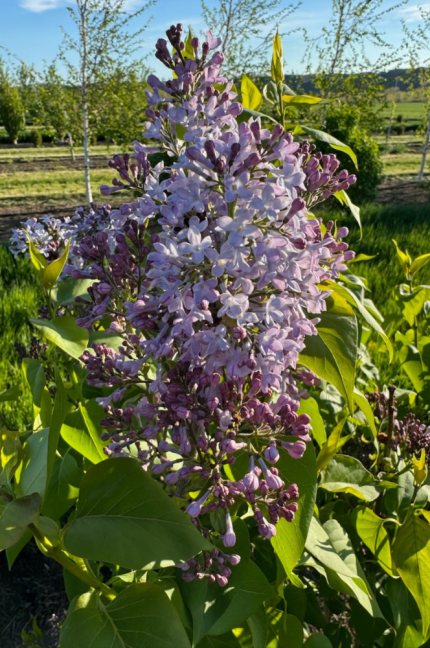
Common Purple Lilac

Fall Red Apple
The Fall Red Apple is an exceptionally cold hardy apple tree that will grow a delicious apple right in your own orchard. The apples are best eaten fresh off the tree or can be used in baking and juicing. On average apples measure 7 - 8cm across, have a dark red skin and white flesh. They are crisp and sweet (12.4 °Bx) with a pleasant flavor. We find that the apple has a some what traditional flavour which in the industry is referred to as being “moderately acidic”. As it’s name describes, apples are best harvested later on in the fall. The apples can be stored in your cold room for up to 90 days. The tree shows moderate resistance to fire blight. The tree tends towards alternate bearing.

Pembina Plum
The Pembina Plum is hybrid between a Canadian and Japanese plum that was bred over 100 years ago. The tree shows a brilliant display of precocious white flowers in the spring and in late August offers an absolutely delicious plum. The fruit displays a dark red skin and yellow flesh. The fruit is of the clingstone variety, which simply describes how the flesh does not easily pull away from the pit. The tree is very cold hardy and makes a fine year around accent tree. It is indeed a glorious moment to walk over to your Pembina Plum and indulge in a sweet and juicy plum you grew right in your own back yard.

Showy Mountain Ash
The Showy Mountain Ash features showy white spring flowers, pinnately compound leaves and striking red fall fruit. The berries often remain on the tree after the leaves fall, which provides a pleasant winter appearance. The tree is excellent at attracting birds to any yard. The leaves are dark green and transition to orange / red in the fall. Bark is typically smooth and grey, becoming scaly as the tree matures. The tree is slow growing and compact, making it a perfect addition to smaller sites. The tree can be planted as an accent or shade tree.

Tatarian Maple
The Tatarian Maple is a compact, exceptionally hardy and low maintenance accent tree. The tree will display showy red samaras in late summer. Fall colours are vibrant, and leaves often remain on the tree well into winter. Interestingly, the tree will often grow wider than it is tall. The trees trunk is a striking light grey with black markings.

Thunderchild Flowering Crab Apple
Thunderchild Flowering Crabapples are an attractive, compact and upright tree that make the perfect focal point for any garden. During middle spring, the branches are draped with clusters of vibrant pink flowers. Its fruit is perfectly edible and tends to remain on the tree long into winter. The tree displays a dark purple foliage throughout the growing season. Thunderchilds are strongly resistant of fire blight. They are an absolute delight for bees, butterflies and birds alike.
