

Black Walnut
Black Walnut Trees are a relatively rare tree for Southern Alberta but they have long been successfully grown in Medicine Hat. They make excellent shade trees and offer a splendid dappled shade with their loose open canopy. As a delicious autumn treat they produce large bounties of rich tasting nuts. They are low maintenance and exceptionally pest and disease resilient. They produce a brilliant fall show of bright yellow leaves. All and all we can not say enough good things about the Black Walnut tree as a consideration for anyones yard with appropriate space.


| Common Name |
Black Walnut |
|---|---|
| Latin Name |
Juglans nigra |
| Form |
Round |
| Life Span |
150+ |
| Growth Rate |
Moderate |
| Mature Height |
20m |
| Mature Spread |
15m+ |
| Flower Colour |
Inconspicuous |
| Fragrance |
Sweet Perfume Scent |
| Fall Colour |
Bright ,Yellow |
| Soil Preference |
Widely adaptable |
| Exposure Preference |
Full sun |
| Cold Hardiness Zone |
Zone 4 |
| Special Attributes and Considerations |
The Black Walnut tree has a special defence mechanism know as Allelopathy. The tree's roots exude a natural herbicide known as juglone. The toxicity of juglones to other plants is still up for debate, but potatoes, tomatoes, apples and lilacs may be stunted if grown within close proximately to a Black Walnut tree. Rest assured, turf grass and Black Walnut trees get along just fine. |
| Folk Lore |
Medicine Hat has 3 Black Nuts trees with Heritage Tree status. These magnificent trees where planted by Mr. Earl Basset and they can be viewed at 114# Third St. NE. Over the years many seedlings have been germinated from the fallen nuts of these original Basset Black Walnut Trees. We even have some seedling of the same linage growing at our farm. |
| Available Sizes |
40mm |
Related products

Golden Willow
The Golden Willow is a hardy shelter belt tree that grows with a round form and slender drooping branches. The tree will grow to a large stature and tends to prefer a low canopy. As implied with it’s name, young stems are adorned with a beautiful yellow hue. The tree grows with glossy green, narrow (lanceolate) leaves. In autumn the leaves will turn golden yellow. As the tree ages the trunk’s bark will become deeply furrowed. The tree is typically found growing in a multi-trunk form, how ever we also have single trunk selections.

Laurel Leaf Willow
The Laurel Leaf Willow is an extremely hardy, large sized tree that is native to Northern Europe. It is noted for having a rounded form, dark green glossy leaves and twisted trunk bark. It produces catkins that are golden yellow in colour. The tree is normally allowed a low canopy and is perfectly content in wet sites. Laurel Leaf willows are very eager to leaf out in the spring and reuctant to drop their leaves in the fall.

Muckle Plum
The Muckle Plum is hybrid between a Canadian Plum and Russian Almond. The tree explodes with a brilliant display of precocious pink flowers in early spring. The leaves are dark green and transition to a warm orange in the fall. The tree is very compact making it a perfect addition to smaller yards. Muckle plums will not grow any fruit so they considered to be very neat and tidy. The tree is cold hardy and makes a fine year around accent tree.

Parkland Pillar Birch
The Parkland Pillar Birch is a beautiful tree that was derived from the Japanese White Birch. The tree grows with a commanding columnar form comprised of very dense dark green leaves. Typical of the birch species, it’s leaves are small, pointed and have serrated margins. The leaves turn to golden yellow in autumn and slowly shed, reviling it’s inner white bark. The Parkland Pillar Birch can be planted as a single accent tree, in a group or as a privacy screen.
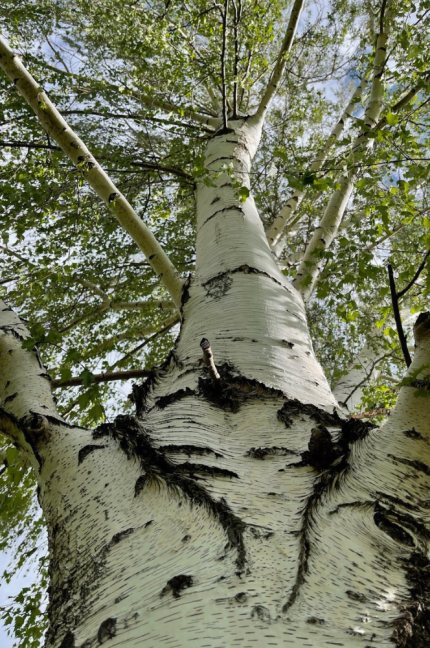
Prairie Dream Birch
The Prairie Dream Birch is a paper birch with beautiful fair white bark and attractive green leaves. With time the bark on the lower trunk peels into neat little rolls that are a favourite for youngsters. The leaves are pointy and dark green with a doubly serrated margin. They turn a golden yellow in fall. This cultivar is low maintenance and more adaptable than other varieties of birch. The Prairie Dream Birch has demonstrated exceptional resilience to the the birch bark borer.

Showy Mountain Ash
The Showy Mountain Ash features showy white spring flowers, pinnately compound leaves and striking red fall fruit. The berries often remain on the tree after the leaves fall, which provides a pleasant winter appearance. The tree is excellent at attracting birds to any yard. The leaves are dark green and transition to orange / red in the fall. Bark is typically smooth and grey, becoming scaly as the tree matures. The tree is slow growing and compact, making it a perfect addition to smaller sites. The tree can be planted as an accent or shade tree.

Thunderchild Flowering Crab Apple
Thunderchild Flowering Crabapples are an attractive, compact and upright tree that make the perfect focal point for any garden. During middle spring, the branches are draped with clusters of vibrant pink flowers. Its fruit is perfectly edible and tends to remain on the tree long into winter. The tree displays a dark purple foliage throughout the growing season. Thunderchilds are strongly resistant of fire blight. They are an absolute delight for bees, butterflies and birds alike.
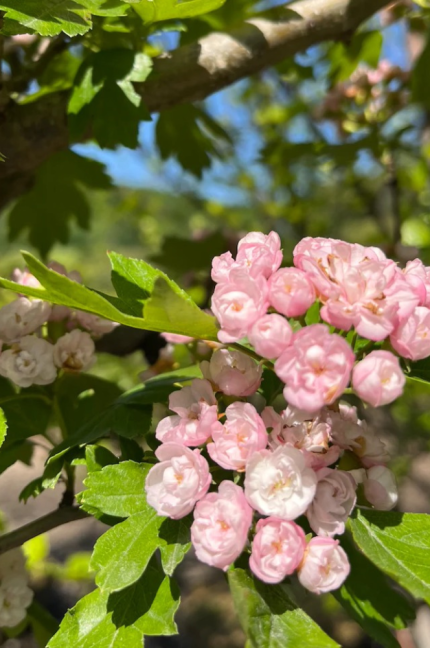
Toba Hawthorne
The Toba Hawthorne is hardy and compact ornamental tree that displays double white flowers that slowly turn to pink. The flowers are followed by small pomes that ripen to red in the fall. These pomes can be made into jellies or used in tea. The tree grows with bright glossy leaves that turn yellow. As the tree matures it develops a sinewy trunk full of furrows and twists.
